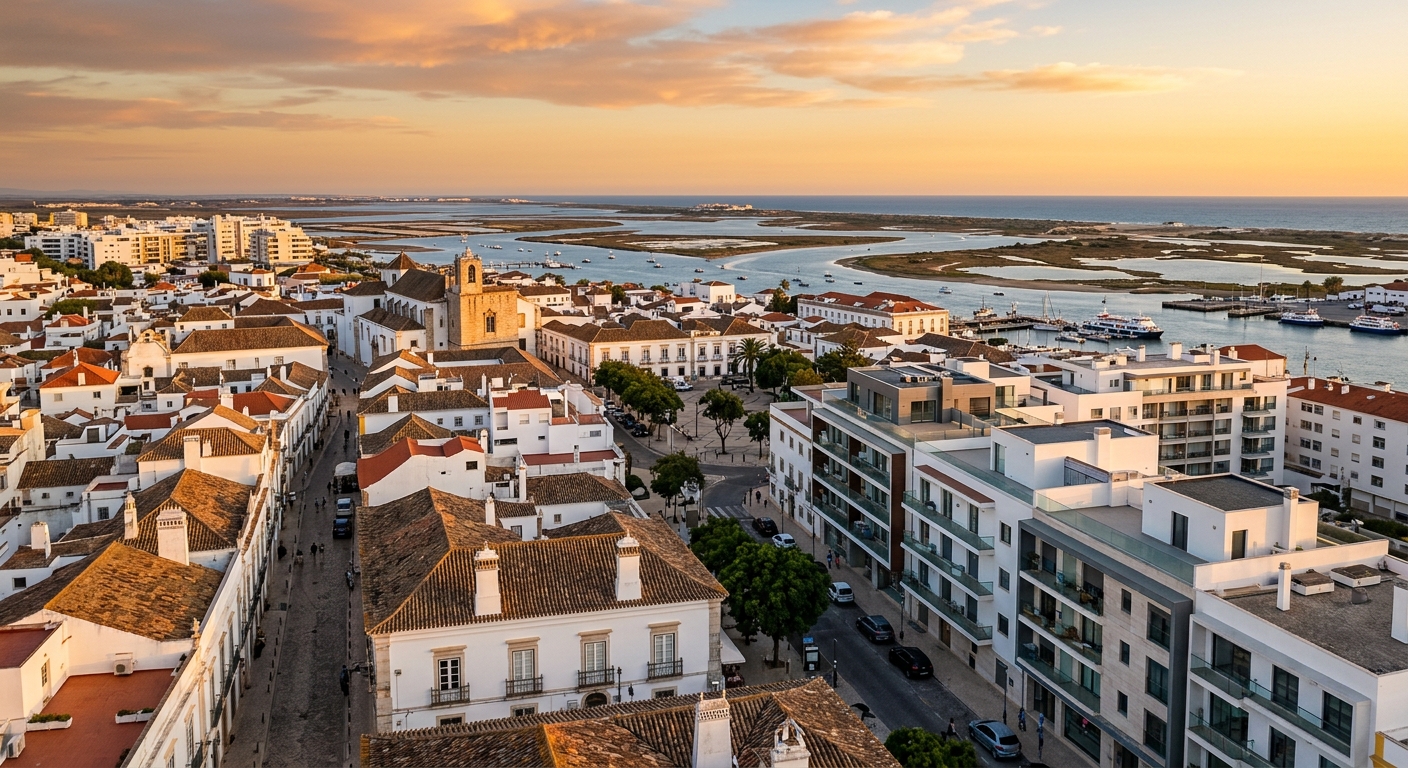
Faro's market in 2026
Faro is the Algarve's capital and the gateway to a region where real estate carries decisive economic weight. In 2026 the market remains supported by tourism, short-term rentals (Alojamento Local, or AL), foreign second-home demand and Portuguese quality-of-life buyers. The average mortgage rate is now 2,8 % [1], restoring purchasing power for the domestic buyer after the high-rate cycle.
INE transaction data shows that Faro municipality sits below neighbouring coastal municipalities like Loulé, Albufeira or Lagos [2]. For sellers, this positions Faro as the most accessible Algarve capital market with airport, beach and full services within reach. For international buyer profiles comparing the Algarve with Lisbon's premium coastline, the Cascais guide covers the equivalent segment on the Estoril Coast.
Prices by area in Faro
Faro divides into sub-areas with very different profiles. Knowing them is essential to position an asking price realistically.
Premium areas (above €2,800/m²)
- Historic centre (Cidade Velha): refurbished stock for foreign buyers and AL investors. UK, Netherlands and Germany are the dominant nationalities.
- Marina and riverfront area: international quality-of-life buyer, Ria Formosa views.
- Penha: large 3-bedroom flats and houses, established family buyer.
Residential areas (€1,900 – €2,800/m²)
- Montenegro: national family profile, close to the airport, sustained appreciation.
- Bom João: central residential area, mix of Portuguese and long-stay foreign buyers.
- Conceição and Estoi (within Faro municipality): more rural, plot-based, return-migrant or second-home profile.
Value areas (€1,400 – €1,900/m²)
- Patacão and Areal Gordo: further from the centre, national family profile, more recent construction.
- Western periphery: lower prices but higher car dependency.
- Older buildings needing significant work in central areas: case by case, may fall in this bracket if refurbishment is substantial.
Indicative average price per m² by area in Faro
Indicative figures based on INE transaction data and Confidencial Imobiliário research notes. Always verify the current parish-level average before setting an asking price.
Faro has strong seasonality: the market peaks April-October with international presence in the area. For second-home-profile properties, launching in early April is the best window. National-profile properties follow the mainland calendar (March and September).
Short-term rentals (AL) in Faro: impact on value
Short-term rental weighs heavily on Algarve real-estate prices. Faro is not in a declared AL contention zone (unlike Lisbon, Porto and Funchal), but the national regime under Decree-Law 128/2014 applies [3]. Properties with well-documented AL track records gain extra liquidity with investors, provided the AL numbers (yield, occupancy) are available and auditable. For the full national rules (CAE, Cat. F vs Cat. B taxation, licence cancellation on sale), see the Short-Term Rental 2026 guide.
Properties without an AL licence in areas where the operation would make sense, or with a suspended licence, lose value with the investor segment. To sell an active AL, prepare a dossier with 12-24 months of revenue, occupancy rate and operating expenses.
The sale process: legal and practical steps
Selling in Faro follows the national legal framework. A well-prepared seller closes in 3 to 6 months; one who improvises drags the process or loses the buyer due to an irregularity surfaced in due-diligence checks.
- Market valuation: at least two valuations from agents active in your area, with closed transactions in the past 12 months.
- Document preparation: updated property tax record (caderneta predial urbana), permanent land registry certificate (certidão permanente), occupancy licence, technical specifications sheet for buildings post-2004, energy certificate, latest condominium minutes and a no-debt statement.
- AL verification: if the property has or had registration, confirm current status, revenue dossier and implications for the buyer.
- Energy certificate: legally required under Decree-Law 101-D/2020 . Issued by ADENE-qualified inspectors in 2 to 5 working days, valid for 10 years . Cost typically €150-€350.
- Visual presentation: in Faro, drone video and view photography (Ria Formosa, sea, rooftops) can be decisive for international buyers.
- Choose your real-estate agent: in Faro, prefer agents with established local presence and proven capacity to sell to foreigners (EN descriptions, international viewing logistics).
- Marketing: national portals (Idealista, Imovirtual) and international portals (Kyero, Green-Acres, Rightmove Overseas, idealista.pt EN).
- Offer evaluation: assess not just price but the conditions (closing horizon, financing, absence of suspensive conditions, deposit offered).
- Promissory contract (CPCV): sets the closing deadline, deposit (10-30 % in market practice) and consequences of default. Have a lawyer review it.
- Public deed (escritura): signed at a Notary Office or at Casa Pronta. The buyer's IMT and Stamp Duty must be paid before the deed .
Get the energy certificate before listing. You cannot legally advertise the property without one and missing it triggers a fine. Valid for 10 years for residential properties.
Seller costs and Portuguese taxes
Selling in Faro comes with costs that often surprise foreign sellers. Knowing them in advance is essential to calculate the net proceeds realistically.
- Agent commission: in Faro the market practice is 5 % to 6 % + VAT (IVA at 23 %). For properties above €500,000 (common in the Algarve), 4 % to 5 % is typical.
- Legal fees (recommended, especially in non-resident transactions): €500-€2,000 depending on complexity.
- Mortgage lifting (if applicable): notary and registry costs of €200-€500.
- Energy certificate: €150-€350.
- Capital gains tax (Portuguese IRS): depends on residency and reinvestment (next section).
Capital gains tax on Portuguese property
Capital gains on Portuguese property are taxed under Article 10 of the Portuguese personal income tax code (CIRS) [4]. The gain is the sale price minus the acquisition value (indexed by the monetary devaluation coefficient), less documented expenses. See also: capital gains on primary-home sale guide.
- Portuguese tax residents: 50 % of the gain is added to other income and taxed at the marginal rate. Aggregation has been mandatory since 2023.
- Reinvestment exemption for primary residence (HPP): if you reinvest in another primary residence in Portugal or the EU/EEA within 36 months after (or 24 months before) the sale, total or partial exemption applies.
- Extraordinary mortgage-amortisation measure: ended on 31 December 2024 and no longer applies in 2026 [8].
- Non-residents: since the 2023 ECJ ruling, non-residents are taxed under the same 50 % aggregation regime as residents.
In the Algarve, many sellers are non-residents who bought years ago. The IRS regime for non-residents changed in 2023 and warrants confirmation with an accountant before accepting an offer. It can materially affect the net proceeds.
Choosing the right agent in Faro
Faro has dozens of agencies, many specialised in international buyers. Quality varies widely. Picking poorly can cost months on the market and tens of thousands of euros in lost value.
AMI licence: the legal requirement
Real-estate mediation in Portugal is regulated by Law 15/2013 and supervised by IMPIC (the Institute for Public Markets, Real Estate and Construction) [5]. Every estate agent must hold an AMI licence (Licença de Mediação Imobiliária) issued by IMPIC. The AMI is a legal authorisation, not a trade association. Verify the AMI number directly on the IMPIC portal before signing any contract. APEMIP and ASMIP are voluntary professional associations.
Algarve-specific criteria
- Local-area knowledge and understanding of the active buyer mix (Portuguese vs international).
- Proven international marketing capability: EN listings, presence on international portals, foreign buyer base.
- Plan to manage international viewings (video calls, flexible scheduling, possibly tourism partners locally).
- Commission transparency and mediation contract with defined term (90-180 days in the Algarve, slightly longer than Lisbon or Porto).
- Verifiable reputation: reviews on independent platforms, presence in public registers, willingness to provide recent client references.
Sell faster in Faro: levers that work
The first impression is decisive. In Faro the weight of international buyers changes the equation: visual presentation and virtual-tour capability matter more than in purely domestic markets.
Visual presentation
- Professional photography. Equipment matters less than technique: high-end smartphones in the hands of experienced photographers deliver solid results. What distinguishes good from bad is composition, well-managed natural light, wide angles without distortion and consistent colour editing. In the Algarve, golden-hour photography is decisive.
- Drone (aerial) video: for properties with Ria Formosa or sea views, this is a differentiator.
- Matterport tour: almost mandatory for properties above €350,000 targeting international buyers.
- Basic home staging: depersonalise, paint in neutral tones, light well.
Pricing strategy
- In Faro the "burned listing" effect is slower than in Lisbon, but real. Adjust the price at 60-90 days.
- International buyers compare Faro with the rest of the Algarve. Communicating value relative to Tavira, Olhão or Loulé can help.
- Listings priced 0-3 % above market value close faster than listings priced 10 % or more above.
Operational flexibility
- Allow viewings, including by tourists on holiday. Some of the best Algarve buyers are on holiday and view properties in parallel.
- Vacant properties sell faster. If you've moved out, tell your agent.
- Have the document set complete before listing. Delays during the buyer's document checks are the most common cause of late buyer withdrawal.
Foreign buyers in Faro: what changed in 2024-2025
Faro has one of the highest shares of foreign buyers on mainland Portugal. For the legal framework that applies equally in the capital, this pairs with the Lisbon guide. Two regulatory frames are often communicated incorrectly. See also the IMT and stamp duty 2026 guide.
Non-Habitual Resident (NHR) is closed; IFICI is the successor
The Non-Habitual Resident regime (NHR, locally RNH) closed to new applications on 1 January 2024 under Law 82/2023 [6]. People who already held NHR continue under the regime until their 10-year window expires. The successor is IFICI (Tax Incentive for Scientific Research and Innovation), created by Ordinance 352/2024/1 [7]. For foreign pensioners planning an Algarve purchase, our IFICI vs NHR comparison explains why the new regime does not cover arrivals after 2024. IFICI is narrower than NHR and does not replace the foreign-pensioner regime that so many Algarve buyers used over the past 10 years.
Golden Visa: no real-estate route
The real-estate routes of the Golden Visa (ARI) were removed on 7 October 2023 under Law 56/2023 [8]. You cannot obtain a Portuguese residence permit by purchasing residential property. Current routes: qualified VC funds (€500,000), R&D, culture, social capital with job creation, direct 10-job creation.
What still works for the foreign buyer
- Full description in EN on international portals (Kyero, Green-Acres, Rightmove Overseas, idealista.pt EN). DE and FR also help.
- Matterport tour or high-quality video: separates serious buyers from tyre-kickers before any trip.
- Flexibility for video calls outside Portuguese business hours.
- Practical support with NIF (Portuguese tax number), opening a Portuguese bank account and, for non-EU non-residents, appointing a fiscal representative.
Common mistakes that cost money
- Pricing by "how much I need" rather than "how much it's worth".
- Signing with the first agent through the door. Compare at least 2-3 agency agreement proposals.
- Skipping document verification before listing, especially in older properties with unreported works.
- Ignoring the international channel when the property suits it.
- Rejecting the first serious offer hoping for better.
- Not preparing the AL dossier when the property has registration, losing investors as a target segment.
Find a real estate consultant in
Compare agents with real reviews
Seasonality and timing in Faro
- January-March: foreign buyers start planning trips to the area. Good window to launch second-home properties.
- April-June: peak of international viewings. National families want to close before summer.
- July-August: foreign buyers on holiday in the area. Unique window for in-person viewings without a dedicated trip.
- September-October: second peak, especially for European buyers.
- November-December: slowdown. Good for preparing the property to launch in January-February.
Rule of thumb for international-profile properties: launch in March or September; accept viewings during July-August if logistics allow.
Realistic timeline in Faro
- Weeks 1-2: preparation. Valuations, document gathering, energy certificate, AL dossier if applicable.
- Weeks 3-4: launch. Professional photography, drone video if applicable, listings prepared.
- Weeks 5-16 (average): active marketing. May run longer when the target audience is international, due to the visit-to-decision cycle.
- After offer acceptance (1-3 weeks): buyer document checks, drafting and signing the CPCV.
- After CPCV (30-120 days): agreed window until the deed. May be longer with foreign buyers setting up NIF and Portuguese bank accounts.
- Deed and registration: 1-3 working days at Casa Pronta; up to 10 days at a Notary Office.
Typical end-to-end timeline from "I want to sell" to money in the bank: 4 to 8 months in Faro depending on the buyer profile. Premium international-profile properties can take longer.
In non-resident transactions, anticipate the logistics of NIF, bank account and fiscal representative. Delays here are the main cause of CPCV extensions.
Ready to move forward?
Faro in 2026 is a market with firm prices, cheaper mortgages than two years ago and strong international demand. Rules have shifted on several fronts (NHR, Golden Visa, capital gains, non-resident IRS) and sellers who communicate the current framework gain credibility with sophisticated buyers. The next step is a rigorous valuation and engaging an agent whose AMI licence you've verified and whose international-sales capability is proven.
Find out how much your property is worth in
Free valuation by reviewed professionals
Referências
- [1]Bank of Portugal — Interest rate on new home loans (series 12533735) ↗(acedido a 2026-05-13)
- [2]Statistics Portugal (INE) — Local Housing Price Statistics ↗(acedido a 2026-05-13)
- [3]Decree-Law 128/2014 — Short-term Rental (Alojamento Local) regime ↗(acedido a 2026-05-13)
- [4]Portuguese Personal Income Tax Code (CIRS) — Article 10 (Capital Gains) ↗(acedido a 2026-05-13)
- [5]IMPIC — Real Estate Mediation Licensing (AMI licence) ↗(acedido a 2026-05-13)
- [6]Law 82/2023 — Portuguese State Budget 2024 (NHR closure) ↗(acedido a 2026-05-13)
- [7]Ordinance 352/2024/1 — IFICI tax incentive ↗(acedido a 2026-05-13)
- [8]Law 56/2023 — Mais Habitação ↗(acedido a 2026-05-13)
This article was written with AI assistance and reviewed editorially by The Agent Trust. All cited sources are official and verifiable in the links above.